
Home » Every African Team at Every World Cup: Complete History (1930–2026)
Africa’s World Cup history is one of the most dramatic in international football․ The continent has fought for respect‚ broken records and changed the game from Egypt’s World Cup debut in 1934‚ to Morocco’s semi-final run in 2022․ The 2026 World Cup will see 48 teams compete in the biggest World Cup ever, and ten of those teams will represent Africa: a World Cup potentially bigger than any of its predecessors․ Here’s the story of Africa’s time at the World Cup: the highs‚ the lows‚ and everything in between․
The Pharaohs were the first African nation to participate in the World Cup‚ representing Africa in the 1934 edition‚ but no African nation participated in the finals of the inaugural tournament in 1930 held in Uruguay․ They lost 4-2 to Hungary in the first round as a controversial result․
Abdulrahman Fawzi added a brace‚ the first World Cup goals by an African‚ and hit the post․ A third goal by Fawzi was disallowed for offside after he had dribbled the length of the pitch‚ as judged by Italian referee W. Giorgio Gatti․ The Egyptian goalkeeper claimed the Hungarian goal was illegal‚ but the officials allowed it to stand․
Egypt did not appear at another World Cup until 56 years later․ They applied for the 1938 edition in France‚ but withdrew when FIFA scheduled a qualifying fixture for a date during Ramadan․ World War II suspended the competition until 1950․
No African teams participated in qualification or the finals during the 1950s. Egypt and Sudan withdrew from the 1958 qualifiers after being drawn with Israel․ The politics surrounding the game were as important then as what was happening on the pitch․
The 1960s were a period of rapid change in Africa․ After the independence of 17 African nations in 1960‚ 16 African nations applied for qualification to England 1966․ FIFA rejected Congo’s application entirely and banned South Africa due to its policy of apartheid․
The bigger issue was that FIFA had allocated just one World Cup spot between Africa‚ Asia and Oceania combined‚ so the African team delegates walked out in protest․ It was the right decision‚ however‚ as their boycott forced FIFA to increase Africa’s allocation․
Morocco became the first African team to play in a World Cup since 1934‚ but finished fourth in a group with West Germany‚ Peru and Bulgaria at the 1970 FIFA World Cup in Mexico․ Although it was not a spectacular debut‚ Houmane Jarir and Maouhoub Ghazouani became the second and third African players to score at the World Cup․
Zaire was the only African representative at the 1974 World Cup in West Germany․ Zaire dictator Mobutu Sese Seko gave each player a car and a house in advance․ After losing 2-0 to Scotland and then 9-0 to Yugoslavia‚ the government allegedly promised that Zaire would not return home if they lost to Brazil by four or more goals․ Zaire lost 3-0 to Brazil and returned home anyway․
In the 1978 World Cup in Argentina‚ Tunisia became the first African country to win a match in the World Cup’s history‚ with their 3-1 win over Mexico․ That was a small step but an important one․ A year later, in 1982, the African quota was raised to two, with Algeria and Cameroon qualifying.
Algeria produced the tournament’s first shock with a 2-1 win over West Germany․ They beat Chile‚ becoming the first African team to win two World Cup group matches․ Cameroon drew all three group matches‚ but lost out on goal difference to Italy‚ who controversially denied an equalizer․ Neither went through, but both had shown that African football had a place at the international level.
Morocco finished ahead of England‚ Poland‚ and Portugal‚ and became the first African country to qualify for the World Cup knockout stage․ In their final group stage match‚ Morocco defeated the Portuguese team 3-1․ They then faced West Germany in their first knockout stage match‚ but lost 1-0 after Lothar Matthaus scored a late winner for the German side in the 88th minute․ But Africa had arrived․
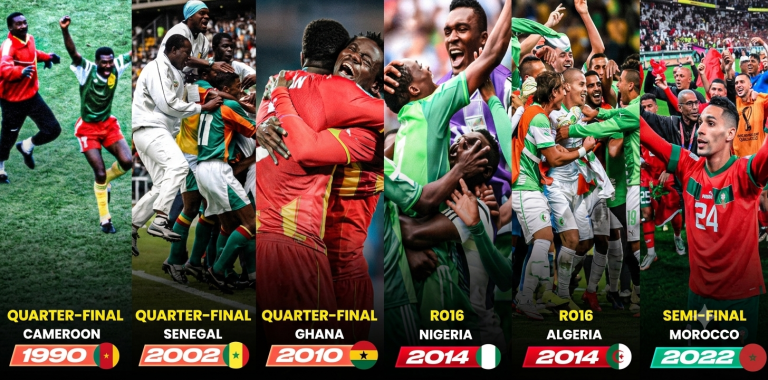
Cameroon appeared at the 1990 World Cup in Italy‚ where the Indomitable Lions defeated defending champions Argentina in their opening game and placed first in a group with Romania and the Soviet Union․ In the last 16‚ 38-year-old Roger Milla scored two goals‚ and put his name firmly in the history books by dancing at the corner flag‚ now one of football’s most recognized images․
The quarter-final saw Cameroon lead England 2-1 with 25 minutes to go before Gary Lineker equalized from the penalty spot and then scored the winner from a penalty in extra time․ Africa had come 25 minutes away from its first semi-finalist․ Even if it had not happened this time around, the continent had proved it could compete with the best; Egypt, having returned to the World Cup stage, was unable to win any matches.
Despite the team’s later achievements‚ the 1994 World Cup was inextricably linked to the almost complete loss of the Zambian squad in a plane crash․ The new team‚ with only two survivors from the Europe-based players‚ went on to win the 1994 Africa Cup of Nations‚ and its story is one of the most extraordinary in football․
Nigeria reached the round of 16 in 1994‚ having beaten Bulgaria 3-0 and Greece 2-0 in the group stage‚ and then losing to Italy 0-1 in the round of 16 in a match Nigerians claim should have gone the other way․ Then, in 1998, after Nigeria dispatched Spain and Bulgaria before Denmark eliminated them, the Super Eagles appeared to have established themselves as Africa’s most consistent World Cup side.
At the 2002 World Cup in South Korea and Japan‚ Senegal’s Lions of Teranga stunned the world by defeating defending champions France in the first match of the season and eliminating Uruguay․ In the round of 16‚ Henri Camara scored a golden goal in the 104th minute to end Sweden’s run, and in the quarter-finals‚ they were eliminated by Turkey’s golden goal․ This was only the second time Africa had reached a last eight․
Ghana made their World Cup debut at Germany 2006 and made an immediate impact by eliminating the Czech Republic and the United States to reach the knockout stage․ The only defeat for the Black Stars came against Italy‚ who were to become eventual winners․ Brazil ended Ghana’s campaign with a 3-0 defeat in the round of 16, but Ghana had finally arrived on the World Cup stage․
The 2010 World Cup was the first to be held in Africa‚ and South Africa was the host. Five African teams featured at the tournament‚ with Algeria‚ Cameroon‚ Ivory Coast and Nigeria joining Ghana; however‚ all four were eliminated in the group stage․ Ghana‚ who was the other remaining African representative‚ defeated the USA in the last 16‚ and lost in the quarterfinals to Uruguay in a match they still rue․
When Ghana and Uruguay were tied 1-1 in the 120th minute‚ Luis Suarez of Uruguay denied a certain goal by handling the ball on the line‚ receiving a red card․ Asamoah Gyan’s resulting penalty kick hit the crossbar․ Even though Uruguay won via the shootout‚ it remains one of the most controversial incidents in World Cup history‚ and Ghana paid the price․
Algeria and Nigeria each reached the round of 16 at the 2014 World Cup in Brazil‚ the first time two African sides advanced at the same tournament․ Algeria pushed eventual winners Germany into extra time before losing 2-1․ Nigeria’s 2-0 defeat to Germany brought an end to the African hopes of more than two countries reaching the last 16․
At the 2018 FIFA World Cup in Russia, Nigeria‚ Egypt‚ Senegal‚ Morocco and Tunisia were each eliminated in the group stage‚ marking the first World Cup since 1982 in which no African team reached the knockout stage․ Senegal was eliminated on fair play points after Japan and Senegal drew on goals scored and cards amassed․
Then at Qatar 2022‚ Morocco broke new ground for the African nation appearances at the World Cup by topping the group featuring Belgium‚ Croatia and Canada without a defeat‚ eliminating the 2010 world champions Spain in the round of 16 via a penalty shootout and reaching the World Cup semifinal after beating Portugal 1-0 in the quarter-final.
After losing to eventual champions France in the semi-finals and Croatia in the third-place play-off‚ Morocco returned home to celebrations across the continent‚ being the first African side in 92 years and 49 Cup matches to have reached the last four․
The story of Africa at the World Cup isn’t over․ With another 10 teams to support in 2026‚ every one of these teams could follow Morocco’s lead and prove everybody wrong․ No one wants to miss Africa’s best when the World Cup kicks off and at GSB Uganda you have markets on every single CAF qualifier‚ every group game and every knockout game․ Join in on the action and place your bets!
Morocco holds that record after reaching the semi-finals at the 2022 World Cup in Qatar. They beat Spain and Portugal on the way before losing 2-0 to France.
Abdulrahman Fawzi of Egypt scored twice against Hungary in 1934, making him the first African player to score at a World Cup finals.
Tunisia beat Mexico 3-1 at the 1978 World Cup in Argentina. It was the first time an African team had won a game at the tournament.
Ten African teams qualified for the 2026 World Cup, up from five in previous tournaments. The expanded 48-team format gives CAF its biggest ever allocation.
Nigeria, Cameroon, and Senegal are among Africa’s most frequent World Cup participants. Each has represented the continent across multiple tournaments and reached the knockout rounds more than once.
No African team has won the World Cup yet. Morocco’s 2022 semi-final run is the closest the continent has come. With nine spots available in 2026, that record could come under serious pressure.