
Home » World Cup 2026 Group G Preview: Belgium, Egypt, Iran and New Zealand – Who Qualifies?
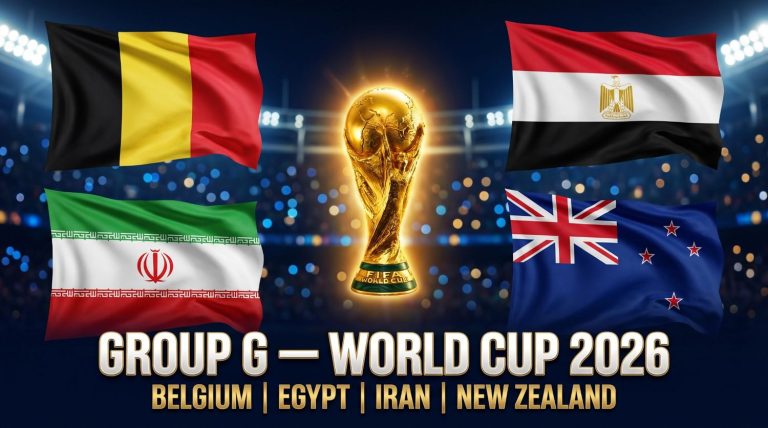
World Cup 2026 Group G brings together four very different footballing nations for what promises to be a fascinating opening phase. Belgium carry the fading hopes of a golden generation, Egypt have Mohamed Salah at the end of his Liverpool career․ Iran are the most tactically astute of Asia’s World Cup qualifiers․
New Zealand are back at the tournament for the first time in 16 years․ Egypt’s Group G performance will also be of interest to audiences in Uganda‚ with the country qualifying alongside the other nine African nations through CAF for the expanded tournament․
Belgium’s golden generation has never won a World Cup. Their peak was a third-place finish in Russia in 2018, built around a sublime Eden Hazard in full prime‚ and Kevin De Bruyne operating as an architect and engine-room operator from controlling midfield‚ but both have since retired or struggled for form․
De Bruyne‚ who left Manchester City to join Serie A side Napoli‚ is the all-time joint-leading European international assist-maker of all time (53)․ Out of his now 34 years‚ his playmaking ability is his strongest asset․ Romelu Lukaku is still a goal-hungry striker‚ even after two difficult seasons with his clubs‚ while Jeremy Doku joins De Bruyne and Lukaku in a Group G lineup that seems a formality on paper․
Group G should suit Belgium’s squad well. Their quality over Iran, New Zealand and Egypt creates comfortable margin for energy conservation ahead of knockout rounds. Nine points and a decent goal difference seem the realistic minimum for a team of this calibre․
Matchday 1 of Group G will be played on 15 June‚ and the double-header final matchday of Egypt vs․ Iran and New Zealand vs․ Belgium was played simultaneously, leaving the race for second place in the group to the final day of the round-robin group stage, which will be finished on 26 June․
Belgium’s first match is against Egypt in Seattle, considered the toughest match on paper in Group G. Three venues. One knockout spot behind Belgium.
Mohamed Salah enters the tournament in peak statistical form‚ having ended the 2024-25 Premier League season as the top scorer with 29 goals and 18 assists‚ with 47 goal contributions‚ the highest in a single 38-game Premier League season․ Salah has scored 30 goals or more in a single season for Liverpool on five occasions, totaling 255 goals in all competitions for the club, and he has won the league’s Golden Boot four times.
The challenge for Egypt lies in what surrounds him. Omar Marmoush’s emergence in the Bundesliga provides another creative outlet‚ but the gap between Salah and his teammates is huge․ Egypt has not won any of their three World Cup matches. Their coach Hossam Hassan is their leading scorer with 69 international goals․ Opponents will be looking to nullify Salah’s opportunities to exploit compact defenses with his movement․
Egypt’s qualification from Group G depends on the result against Iran on 26 June: a win will secure second place․ Defeat makes progression extremely difficult regardless of earlier results. Egypt’s full squad and tactical setup rewards closer reading before forming any predictions.
Iran qualified for four consecutive World Cups and seven overall, currently ranked 21st in the world and coached by former player Amir Ghalenoei. They dropped only one match in Asian qualifying. That consistency is not accidental. Iran operates with a structured defensive organisation that frustrates better opponents, and they counter-attack at pace when space opens.
Olympiacos’s Captain Mehdi Taremi is their main attacking threat․ He has scored 57 goals in 102 caps to date‚ making him Iran’s third ever-best goalscorer․ In March 2025‚ he scored twice against Uzbekistan to send Iran to the 2026 World Cup‚ with the first being an 83rd minute equalizer. That temperament under pressure matters at a World Cup.
The risk defensively for Iran comes when they are forced to play catch-up games. Losing to Belgium or Egypt would require a tactical adjustment this team’s not built for‚ and the resulting chaos will leave them just as vulnerable․ Even if Sardar Azmoun’s injury panic leaves Iran without options‚ their qualifying campaign showed they’ve got what it takes to play their way into round of 32․
This is the first New Zealand World Cup since 2010․ Their biggest challenge will be to keep the quality of Belgium and Egypt at bay for 90 minutes with few goals leaking in. Chris Wood’s experience in the Premier League is a key attacking attribute, while his aerial ability makes him a threat from set pieces․
Set-piece defensive organisation was exposed by Finland during the March window – a weakness that coaching staff will drill before the tournament starts. New Zealand will compete and will cause problems from dead balls. Their chance of advancing hinges almost entirely on the Iran game, where a point could prove enough. Consistent point accumulation across all three matches, though, seems beyond a squad that are heavy underdogs in every fixture.
Belgium vs Egypt – June 15 Salah against an elite Belgian backline produces the group’s most watchable opening fixture. Belgian defensive organisation should limit Egypt to counter-attacks, but Salah finds the net at least once. Belgium have the quality to control possession and pick their moments, so expect a professional win. Belgium win 2–1.
Iran vs New Zealand – June 15 Taremi’s movement and finishing should prove too much for Oceanian defenders. Iran’s defensive shape gives them a platform to absorb early New Zealand pressure before striking on the break. New Zealand will push but lack the firepower to cause a real upset. Iran win 2–0.
Belgium vs Iran – June 21 Iran defend deep and frustrate Belgium for long periods․ De Bruyne’s passing will eventually unlock the structure‚ but it will be a patient‚ grinding performance rather than a statement one․ Belgium grind out the points they need. Belgium win 2–0.
New Zealand vs Egypt – June 21 Salah and Marmoush combine too effectively for New Zealand to contain. Wood scores a consolation from a set piece, giving the All Whites something to build on heading into the Iran match. Egypt control the game but do not put it to bed early. Egypt win 2–1.
Egypt vs Iran – June 26 The group’s defining fixture. Iran’s defensive discipline meets Egyptian dependency on Salah, and Iran edge it through collective organisation and a clinical Taremi finish. Egypt push hard late but cannot find the equaliser. Iran win 1–0.
New Zealand vs Belgium – June 26 Belgium rotate players with qualification already secured. New Zealand, whose tournament is already over, struggle to hurt a rotated but still capable Belgian side. Belgium win 3–0.
|
Position |
Team |
Points |
|
1st |
Belgium |
9 |
|
2nd |
Iran |
6 |
|
3rd |
Egypt |
3 |
|
4th |
New Zealand |
0 |
Egypt carry the hopes of the continent into this group, and their June 26 clash with Iran is the moment that defines Africa’s return on Group G. Ten CAF nations made it to North America, and Salah’s side have the individual quality to reach the knockout rounds – it just depends on what surrounds him.
Follow along as the group unfolds, and check our full Africa World Cup 2026 qualifiers guide for the complete picture on every CAF team’s path and draw.
Has Uganda qualified for the 2026 World Cup? No. Uganda finished second in CAF Group G with 18 points, level with Mozambique but ahead on goal difference. Algeria topped the group with 25 points and qualified directly. Uganda were then eliminated as one of the five worst runners-up across CAF’s nine groups, ending a campaign that had shown genuine promise.
Uganda did not qualify. They came close, finishing second in their CAF qualifying group and winning matches against Guinea and Somalia along the way. The final defeat to Algeria on the last matchday ended their hopes and left them just outside the playoff places based on the runners-up rankings.
Nine African nations qualified automatically for the 2026 World Cup: Senegal, Ivory Coast, Egypt, Cape Verde, Ghana, Morocco, Tunisia, Algeria and South Africa. DR Congo earned a tenth spot through the inter-confederation play-offs, giving CAF a record representation at a single World Cup.
The tournament group stage has not started yet. Group G contains Belgium, Egypt, Iran and New Zealand. Play begins on June 15, 2026 at Lumen Field in Seattle. The live table will update as matches are played across the three matchdays.
Ten African nations will play at the 2026 World Cup. The expanded 48-team format allowed CAF to send more teams than in previous tournaments, up from five in 2022. Each of the ten qualifiers was drawn into one of the 12 first-round groups.